Service
Deck Replacement
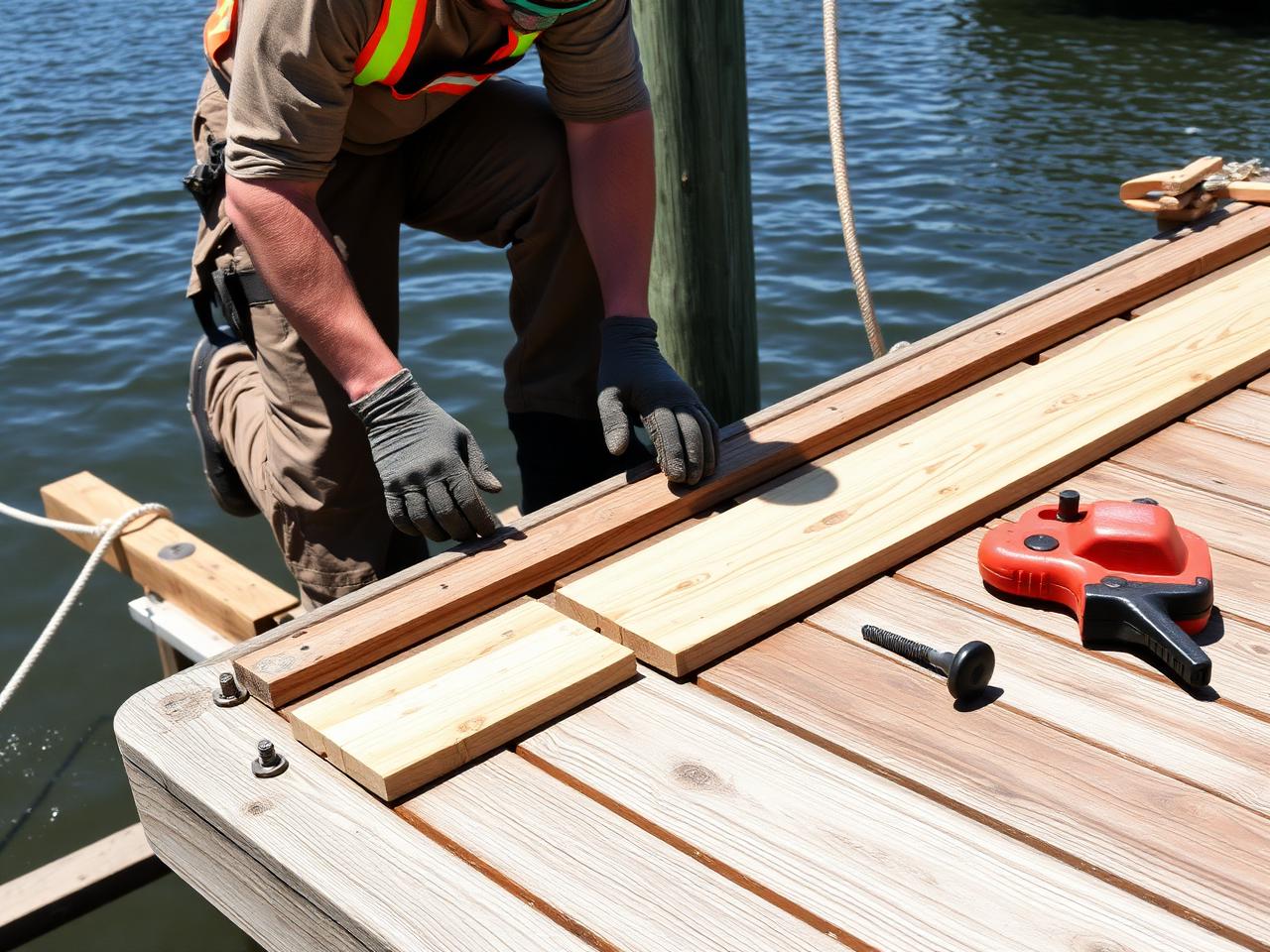
Full or partial deck replacement with marine-grade lumber and stainless or hot-dipped hardware. We size, space, and fasten everything to last on the water — and to pass inspection.
Leave a phone number or email — no account needed.
What's included
- Full or partial deck board replacement
- Joist, ledger, and stringer evaluation and repair
- Marine-grade pressure-treated, Ipe, or composite decking options
- Stainless or hot-dipped galvanized fasteners rated for ACQ/MCA lumber
- Proper 1/8" to 1/4" board spacing for drainage and seasonal movement
- Old material haul-away, fastener pickup, and clean job site
Why hire a specialist
Maryland waterfront work is not the same as a backyard deck. Saltwater, tides, and regulated tidal zones punish shortcuts. Here's what we bring that a general handyman doesn't:
- We size joist spans and board thickness for the marine load case — not a standard backyard deck spec.
- We choose decking material for your sun exposure, salt level, and budget — not whatever's at the big-box store.
- We never use standard zinc fasteners with modern PT lumber. Wrong fastener = rust streaks and pulled boards in under two years.
- We coordinate the County and MDE paperwork when full replacement triggers a permit.
- We pull and dispose of old creosote or arsenic-treated lumber properly — Maryland has disposal restrictions.
- Insured, local, and accountable — we're still here next season when something needs adjustment.
Maryland building & environmental standards
Work in and over Maryland tidal waters is governed by overlapping state, county, and federal rules. We build to these so your pier passes inspection and survives the Bay.
MDE Tidal Wetlands — Repair-in-Kind
Replacing decking and framing within the existing pier footprint is generally considered repair-in-kind under COMAR 26.24, but expanding length, width, or piling count crosses into a Tidal Wetlands License application.
Critical Area Buffer
Material staging, demo debris, and any disturbed soil within the 100-ft Critical Area Buffer must be controlled. We use containment and haul out same-day to stay compliant with COMAR 27.01.
IRC Deck Construction (R507)
Joist sizing, span tables, ledger attachment, and lateral load connections all follow International Residential Code R507. We size to the load path, not by eye.
Fastener Spec for ACQ/MCA Lumber
Modern pressure-treated lumber requires fasteners that meet ASTM A153 hot-dip galvanized or stainless 304/316. We default to 316 stainless for anything touching saltwater.
Board Spacing & Drainage
Boards installed with proper gap (typically 1/8" – 1/4") so water drains, debris doesn't pack in, and seasonal swell doesn't cup the deck. This is what separates a 5-year deck from a 20-year deck.
Treated Lumber Disposal
Old CCA or creosote-treated pier lumber cannot go in regular trash in Maryland. We haul to an approved facility and document disposal.
Informational only — actual permit requirements vary by county and specific site conditions. We coordinate with MDE and your local permitting office on every job that needs it.
Our process
- 01
Walk-through with you to scope full vs. partial replacement.
- 02
Written estimate including materials, fasteners, and disposal.
- 03
Permitting if required — we file with County and MDE.
- 04
Demo, build, and clean — most jobs finish in 2–5 days.
Ready to talk about your pier?
Leave a phone number or email and we'll reach out within one business day to schedule a free on-site look.